

IPTV UK Guide (2026): How IPTV Works in the UK, What to Check, and a Simple Setup Checklist
IPTV UK Guide (2026): this page explains what people mean when they say “IPTV in the UK,” how internet TV delivery works, and what to verify before choosing a setup for a British household.
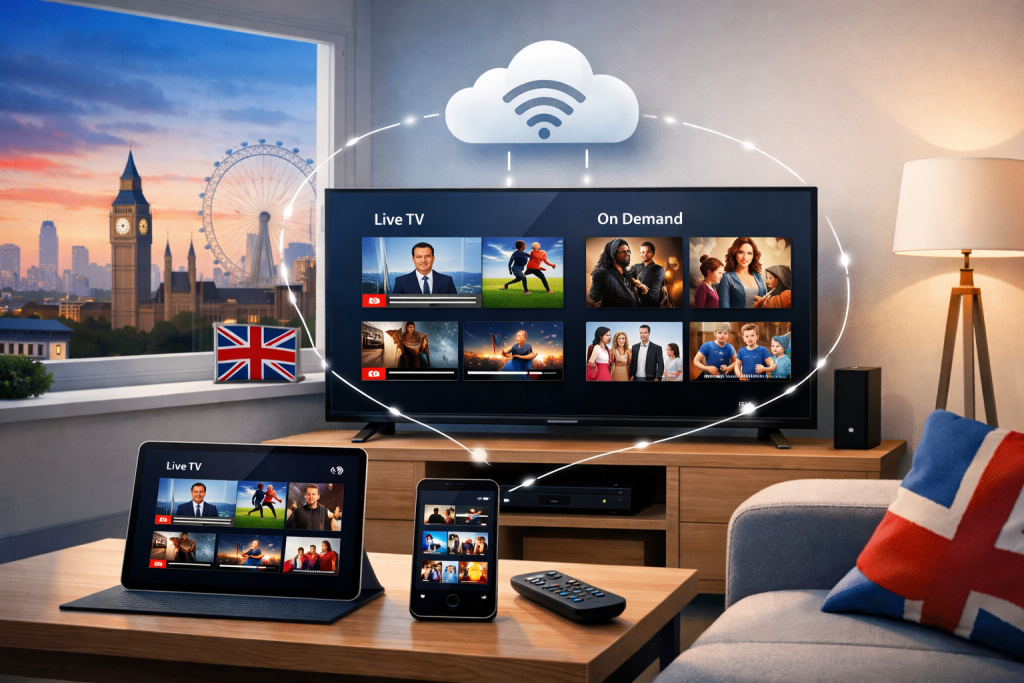
📌 IPTV UK Guide: What people mean by “IPTV in the UK”
In everyday use, “IPTV in the UK” usually refers to internet-delivered TV viewing used by people located in the United Kingdom — not one single provider or one fixed product. The phrase often points to a setup that works reliably on British broadband or fibre, fits the devices most UK households already use, and remains stable during peak-time viewing.
This IPTV UK Guide is written to help you judge a setup the right way: by focusing on reliability, usability (EPG + categories), and the practical checks that reduce buffering, freezing, and messy navigation. The buzzword itself doesn’t matter — the quality of the setup and the legitimacy/authorisation of what you access does.
- works reliably on UK broadband or fibre connections
- fits common home devices (Smart TVs, Fire TV/Android TV boxes, mobiles, PCs)
- includes a usable program guide (EPG) and clear categories
- handles peak-time viewing (evenings and weekend sports)
🔄 IPTV UK Guide: How internet TV delivery works (simple version)
Internet TV delivery is simple at a high level. Your device requests a stream, the player app decodes the video, and separate guide data (EPG) loads to show what’s on now and what’s next. That’s why stability often matters more than headline speed.
- Your device requests a stream over the internet.
- A player app (on the TV or streaming device) decodes the video for playback.
- Guide data (EPG) loads separately to power schedules, “Now/Next,” and search.
Many homes pay for fast packages and still see buffering because the living-room Wi-Fi is weak, the router is overloaded, or the device can’t decode efficiently. Fixing the “last few metres” of the connection can do more than switching apps.
⭐ Why UK households choose internet-based viewing
People in the UK often move toward internet-based viewing for practical reasons rather than hype. A good setup can feel more flexible than older TV delivery methods, especially when you want to watch across multiple screens and keep the living room simple.
- less reliance on long contracts or physical installations
- watching across multiple screens (TV + mobile)
- catch-up and on-demand convenience
- more control over how the living-room setup behaves
The trade-off is that performance depends on internet conditions. That’s not a problem if you test properly and optimise the basics.
📺 Devices that usually work well in UK homes
Most UK households land in one of these “device buckets.” The best choice depends on your room layout, Wi-Fi strength, and how sensitive you are to app speed and updates.
- Smart TV apps (convenient, but updates can be slower)
- Streaming sticks/boxes (often faster, more frequent updates)
- Mobiles/tablets (good for testing and quick checks)
- Laptops/PC (useful for diagnostics and stable Ethernet tests)
Tip: If the TV app feels slow or crashes, a small streaming device can improve playback and Wi-Fi performance without changing your whole setup.
✅ IPTV UK Guide Checklist: What to check before you choose anything
If you only do one thing from this page, do this checklist. It prevents most “I paid and it buffers” situations because it forces you to test the right variables at the right time.
IPTV UK Guide Tip: 1) Test at the right time
- Run tests in the evening (UK peak hours), not midday.
- Try a weekend slot if you mainly watch live sports.
- Watch continuously for 20–30 minutes to judge stability, not just “does it load.”
2) Confirm your living-room Wi-Fi is actually strong
- Check the TV/box location vs router distance (walls and floors matter).
- If possible, test Ethernet once to remove Wi-Fi from the equation.
- If Wi-Fi is weak, mesh or repositioning the router often beats switching apps.
3) Look for a clean guide and sane categories
- Clear categories beat “huge lists” with messy navigation.
- A working EPG is a usability feature, not a bonus.
- Search should return accurate results quickly (slow search usually means a heavy interface or poor indexing).
4) Short-term testing is safer than long commitments
- Trials or short plans help verify stability and support response.
- Use the test window to check your real usage (evenings, live events, and the devices you actually use).
🧭 What “good performance” looks like (so you can judge properly)
People often judge a setup based on the first 30 seconds. That’s misleading. Use these signals instead so you can compare options fairly and avoid false positives.
- Fast start: streams begin quickly and don’t stall repeatedly.
- Consistency: playback remains stable for 20–30 minutes.
- Peak resilience: evenings don’t suddenly become unusable.
- Device stability: the app doesn’t crash when browsing categories or opening the guide.
📶 UK broadband and Wi-Fi: the stability basics that matter most
In the UK, “fast internet” is common — stable internet is the real goal. Two households can have the same package and completely different experiences depending on router quality, Wi-Fi interference, and how busy the home network is.
Wi-Fi interference (the hidden problem)
Many living rooms sit in the worst possible Wi-Fi environment: thick walls, neighbouring routers, and devices competing for airtime. If your TV is far from the router, even a premium package won’t fix dropouts. A mesh node, a better router placement, or an Ethernet run can be the most effective upgrade.
Ethernet as a one-time test
You don’t have to use Ethernet forever. But doing a one-time Ethernet test is the fastest way to answer a big question: “Is the problem my Wi-Fi or something else?” If Ethernet is stable and Wi-Fi isn’t, you’ve found the bottleneck.
Peak-time reality (evenings and weekends)
UK evenings are the toughest test. The home network is busy, neighbours are online, and live sports events create sudden demand spikes. A reliable setup should still feel usable when it matters most — not only at midday.
📘 The EPG (schedule/guide): why it changes the whole experience
For many people, the EPG is the difference between “this feels like real TV” and “this feels like a messy stream list.” A good guide loads quickly, matches channels correctly, and respects UK time zones so “Now/Next” makes sense.
- Correct time zone: listings should align with UK time without manual hacks.
- Channel matching: channels must map to the right guide IDs.
- Speed: scrolling should feel smooth on your actual device.
- Search: finding shows should be fast and accurate.
⚠️ Common problems (and what they usually mean)
“It buffers every few minutes”
Most often, this is Wi-Fi interference or router congestion. Try a one-time Ethernet test. If Ethernet is stable, fix Wi-Fi coverage rather than switching apps endlessly.
“It’s fine in the afternoon but awful at night”
That’s classic peak-time pressure. The combination of home network demand and wider network load can reveal weak points. A stable setup should still be watchable during the hours you actually watch.
“The guide is wrong or missing”
Guide data (EPG) is separate from the stream. Wrong time zones, poor channel mapping, or unreliable schedule feeds cause this. If the guide is important to your household, treat it as a core requirement.
“It works on my phone but not on the TV”
TVs often have weaker processors and slower app environments. A streaming stick or box can improve stability, speed, and overall navigation without changing the rest of your household setup.
⚖️ Legal and safety notes for UK viewers
IPTV is a delivery technology used by legitimate platforms and broadcasters. Legal issues typically relate to whether content is distributed with proper authorisation. If you’re evaluating any setup, it helps to keep expectations realistic and prioritise transparency.
- Prefer providers that communicate clearly and publish straightforward terms.
- Avoid unrealistic claims (for example, “every premium channel forever” with no explanation).
- Keep device firmware and apps updated (TVs and routers included).
- Only access content you’re authorised to view.
🧠 IPTV UK Guide FAQ
Do I need fibre for smooth streaming?
Fibre helps, but stability matters more than headline speed. A steady connection with low jitter and packet loss can outperform a faster but unstable line — especially on Wi-Fi.
Why does it buffer more in the evening?
Evening demand is higher (both in-home and across networks). That’s why testing at the time you actually watch is essential. An Ethernet test once is the quickest way to isolate whether your Wi-Fi is the problem.
Is the EPG always accurate?
Not always. EPG relies on separate schedule data. The best experience comes from correct time zones and correct channel-to-guide mapping. If the guide is wrong, usability drops quickly — treat EPG quality as a key requirement.
What’s the simplest “good” setup for a UK living room?
A stable broadband line, strong Wi-Fi coverage (or Ethernet), and a device that runs smoothly (often a streaming stick/box) usually delivers the best day-to-day experience.
🧠 Final takeaway
The strongest UK setup comes down to three things: stable broadband, good in-room Wi-Fi (or Ethernet), and a well-maintained, transparent source. Follow the IPTV UK Guide checklist, test at peak time, and prioritise usability (EPG + categories) over exaggerated claims.
🌐 External Resources
- Ofcom: TV, radio and on-demand overview
- Cloudflare: What streaming means (network basics)
- IPTV definition (Wikipedia)
- Electronic program guide (EPG) overview (Wikipedia)
- Streaming media overview (Wikipedia)