

IPTV Free Trial Guide (2026, UK): What to Test Before You Subscribe
A short trial can save you weeks of frustration. Use it to confirm three real-world signals:
peak-time stability, device compatibility, and whether the
categories you actually watch work smoothly on your home internet.
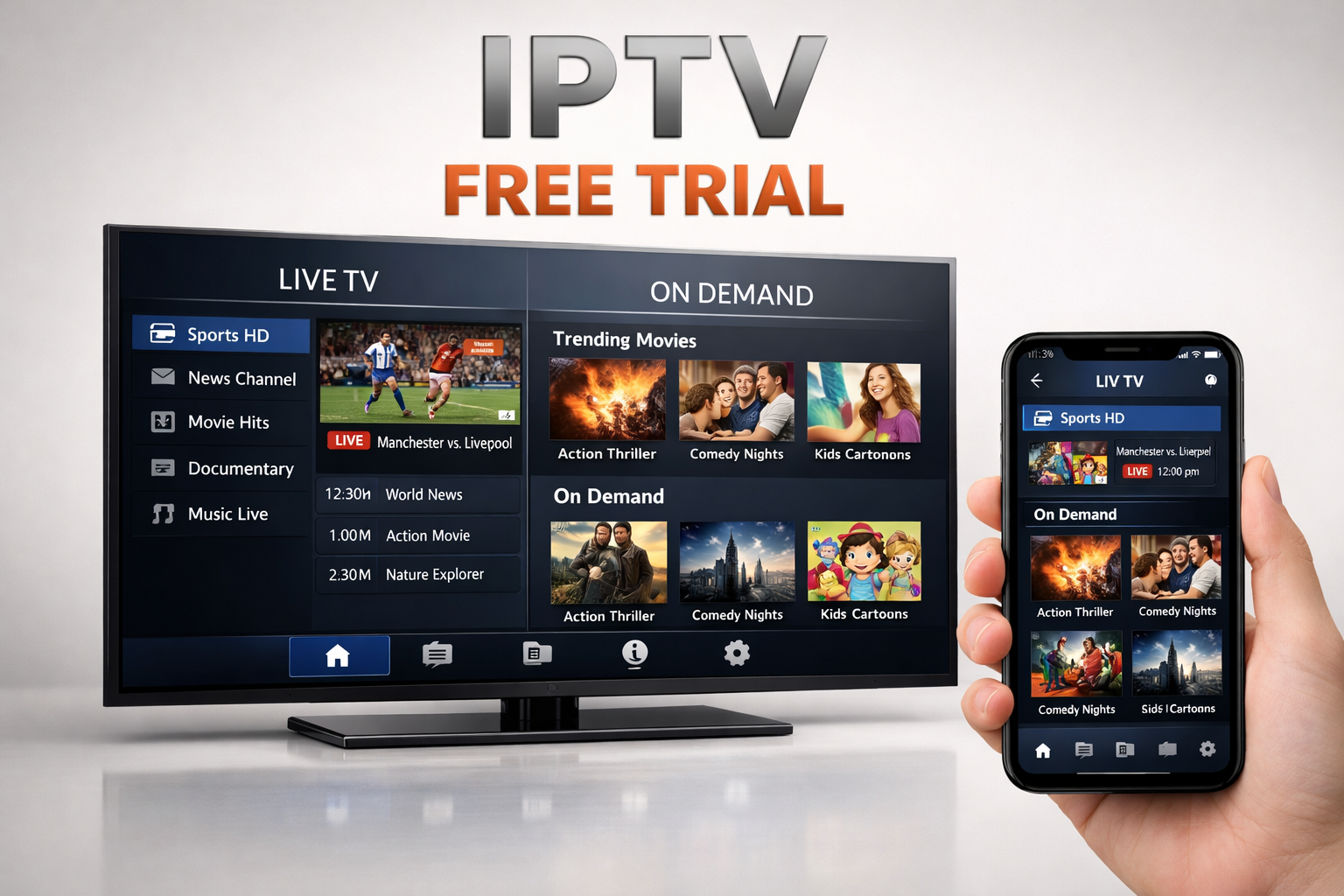
Hero image pack (copy/paste):
- Image prompt: Photorealistic UK living room. A smart TV displays a generic “Trial Test Dashboard” with neutral cards (Peak-Time Stability, Channel Switch Speed, EPG Accuracy, VOD Browsing, Multi-Device Check, Support Response). A single streaming stick/box and one remote on the table. A phone shows the same generic dashboard. No logos, no channel names, no copyrighted content. Soft daylight, realistic reflections, professional product photo, 16:9, high detail.
- SEO filename: iptv-free-trial-uk-2026.webp
- Exact alt text: IPTV free trial offer displayed on smart TV and mobile streaming app
Only access content you’re authorised to view and review the provider’s policies before paying.
Quick answer: what should you test?
- Peak-time stability: does live playback hold up between 7–11 PM UK time?
- Switching speed: fast channel changes without long spinners
- Device fit: your main TV device + one backup device (phone/tablet/laptop)
- Guide & organisation: EPG alignment, search, favourites, categories
- Support response: how quickly they resolve setup or login issues
If you only test at midday, you don’t learn what happens when everyone is online. Peak hours are the truth serum.
Internal links (safe)
- Installation Guide (device setup)
- IPTV Subscription Guide
- What Is an IPTV Player?
- How IPTV Streaming Works
- IPTV Providers 2026 (UK)
This page is informational. If you’re comparing options, use the checklist and test plan below to avoid guesswork.
Table of contents
- What an iptv free trial is (and what it isn’t)
- Why services offer trials
- Before you start: prep for a fair test
- IPTV Free Trial Guide checklist (use this during the trial)
- Peak-hour testing (UK timing)
- Device testing: your main TV + a backup
- Quality checks: SD/HD/4K without false conclusions
- EPG, search, favourites: the “daily usability” layer
- Support response: the hidden quality signal
- Common trial limits (and how to interpret them)
- A simple scoring sheet (so you don’t rely on vibes)
- If buffering happens: isolate the cause fast
- How to pick a trustworthy service (practical signals)
- Trial vs paid plan: what changes
- FAQ
- External resources & related posts
1) What an iptv free trial is (and what it isn’t)
A trial is a short window — sometimes a few hours, sometimes a day — designed to answer one question:
Will this service work smoothly on your setup?
It’s not a perfect simulation of “forever performance”, but it’s still the best risk-reduction tool you have.
Why? Because performance is shaped by your home network (router placement, Wi-Fi interference, Ethernet availability),
your device (decoding ability and memory), and upstream load (how the service behaves when many people watch at once).
A service that stays smooth during real viewing hours is usually the one you keep.
If you’re new to this space, it helps to separate provider and player.
The provider affects stream availability and stability; the player is the app interface that loads those streams.
A great app can’t fix upstream overload, and a great provider can still feel annoying if your app is poorly configured.
(Related reading: What Is an IPTV Player?)
2) Why services offer trials
Trials exist because most people don’t know how a service will behave on their exact combination of:
internet routing, home Wi-Fi environment, and device model.
A quick test reduces the perceived risk of buying a plan.
From your perspective, a trial should validate:
- Stability: the stream holds without frequent buffering or freezes
- Speed: channels load quickly and switching isn’t painful
- Organisation: categories, guide, and favourites make daily use simple
- Support: help exists when something breaks (setup issues are common)
A service can look “amazing” for 5 minutes and still fail during peak hours. That’s why timing matters.
3) Before you start: prep for a fair test
Most “bad trial experiences” come from preventable home issues. Do these first so you don’t judge a service unfairly:
Network baseline
- If possible, try Ethernet on your main TV device (even temporarily).
- Prefer 5GHz Wi-Fi if Ethernet isn’t possible.
- Keep the device within a reasonable range of the router during testing.
Ethernet is the fastest way to discover whether your Wi-Fi environment is the bottleneck.
Device hygiene
- Restart the device before testing (clears memory issues).
- Ensure you have free storage (low storage can cause stutter and app instability).
- Close background downloads/updates during live testing.
Low-memory sticks/boxes can look “laggy” even with good streams.
Clean input
- Copy/paste credentials or playlist links (don’t type them).
- Remove hidden spaces at the end of URLs.
- Paste into a plain note app first, then copy again (removes formatting).
Many “login failed” issues are one invisible character.
If you need device setup help, use your internal guide:
Installation Guide (device setup).
4) The practical checklist (use this during the trial)
This is the checklist most people wish they had on day one. Don’t try to test everything — test what predicts long-term happiness:
| Test | What “good” looks like | What “bad” looks like |
|---|---|---|
| Peak-time live playback | Stays stable for 30–45 minutes | Frequent buffering/freezes after a few minutes |
| Channel switching | Loads fast without repeated spinners | Long delays, hangs, or crashes |
| Category browsing | Menus feel responsive | UI feels sluggish or locks up |
| Guide (EPG) | Shows programmes correctly (if provided) | Empty guide or wrong time alignment |
| Support response | Clear, timely help | No reply, copy-paste answers, or confusion |
5) Peak-hour testing (UK timing)
The biggest mistake is testing at random times that don’t reflect real load. In the UK, the most revealing window is usually:
7 PM to 11 PM, especially Friday and the weekend.
Here’s a simple plan that works even on a short trial:
- Pick one live channel you’d genuinely watch and leave it on for 20–30 minutes.
- Switch 10 times across a few categories (news, entertainment, kids, sport).
- Return to the first channel and continue for another 10–15 minutes.
If it only fails at night, that usually indicates peak-time load sensitivity. If it fails all day, the issue is broader (or your network/device needs attention).
6) Device testing: your main TV + a backup
A trial should always include the device you’ll actually use most. For many UK households that means a streaming stick/box on the main TV.
Then use one backup device (phone, tablet, or laptop) to isolate whether issues are device-specific.
Main TV device (the real test)
- Does playback stay stable for long sessions?
- Is navigation smooth enough for daily use?
- Does the device overheat or slow down after 20–30 minutes?
If the TV device struggles but your phone is fine, it often points to device limitations rather than the service.
Backup device (fast isolation)
- Try the same channel at the same time.
- Compare switching speed and buffering pattern.
- If possible, test on mobile data once (hotspot test).
A hotspot test helps separate “home network issue” from “upstream issue.”
7) Quality checks: SD/HD/4K without false conclusions
Quality tests can go wrong when people jump straight to the highest option. A smarter approach is step-up testing:
- Start with SD for 5 minutes (this should almost always be stable).
- Move to HD and repeat (most households will live here).
- Only then test 4K if you truly need it.
If 4K stutters, don’t assume it’s the provider. 4K is more sensitive to Wi-Fi strength, router congestion, and device decoding ability.
That’s why Ethernet or strong 5GHz Wi-Fi matters when you test higher bitrates.
A “good” service for most people is one that stays stable in HD at peak time with clean switching and usable organisation.
8) EPG, search, favourites: the “daily usability” layer
Many trials focus only on “does it play?” and ignore the part that shapes daily satisfaction: browsing.
Even a stable stream can feel annoying if the guide is empty, categories are chaotic, or favourites are hard to manage.
EPG (programme guide)
- Open the guide and confirm programmes align with the current time.
- If the guide is blank, check your device time/timezone first (wrong time breaks guide alignment).
- Refresh the guide and wait 60–120 seconds before judging.
Search & favourites
- Add 10–20 favourites you’d genuinely watch.
- Confirm the favourites list loads quickly (this predicts a “feels fast” daily workflow).
- Check whether categories can be hidden or reduced (huge menus make everything feel slower).
9) Support response: the hidden quality signal
In real life, something eventually breaks: a playlist stops loading, the guide disappears, or your device needs a fresh setup.
Support is what decides whether a small issue becomes a multi-day headache.
During the trial, send one simple question like:
“What is the recommended setup method for my device, and where do I enter the details?”
- Good sign: clear steps, fast reply, troubleshooting suggestions.
- Bad sign: no reply, vague answers, or pressure to buy without help.
This is a practical trust signal — not marketing. If support is helpful before payment, it’s usually better after payment too.
10) Common trial limits (and how to interpret them)
Trials often include restrictions to prevent abuse. That doesn’t automatically mean the service is poor — it just changes how you test.
Short duration
Many trials are only a few hours or 24 hours. Prioritise peak-time testing and your main TV device first.
Limited categories
Some trials provide a reduced library. That’s fine — you’re testing stability, speed, organisation, and support quality.
Single device / one connection
If only one device can be connected, use the main TV device during peak time. Use a backup device only briefly for isolation.
Feature limitations
Some services limit replay/catch-up or certain UI features. Focus on whether the core experience is stable and usable.
11) A simple scoring sheet (so you don’t rely on vibes)
Here’s an easy 0–5 scoring sheet you can use. Total it at the end of the trial and compare fairly.
| Category | Score (0–5) | What to look for |
|---|---|---|
| Peak-time stability | __ / 5 | 30–45 minutes live without frequent buffering |
| Switching speed | __ / 5 | Fast loads, no repeated long spinners |
| Device performance | __ / 5 | Main TV device stays smooth; no overheating/lag |
| Usability (EPG/search/favourites) | __ / 5 | Guide works (if offered), favourites are quick, menus aren’t chaotic |
| Support response | __ / 5 | Clear, timely help with setup and troubleshooting |
12) If buffering happens: isolate the cause fast
Buffering is usually a pattern problem. Don’t guess — isolate. Use this short flow:
Step 1: Change one variable
- Move closer to the router, or switch to 5GHz if you were on 2.4GHz.
- If possible, test Ethernet briefly.
Step 2: Try a second device
- If the phone is smooth but the TV device buffers, the device may be the bottleneck.
- If both buffer identically, the issue is more likely upstream or network-wide.
Step 3: Hotspot test (optional but powerful)
- If hotspot fixes buffering, your home network/ISP routing is likely involved.
- If hotspot doesn’t fix it, it’s more likely upstream load or server issues.
Related technical background: How IPTV streaming works.
13) How to pick a trustworthy service (practical signals)
“Trustworthy” in practice means transparent expectations, clear help channels, and policies that reduce confusion.
During a trial, look for signals that the service is professionally managed:
- Clear terms: what the plan includes, device limits, and support boundaries
- Refund policy: understandable and easy to find
- Support clarity: setup help that doesn’t feel rushed or vague
- Responsible use messaging: discouraging misuse and clarifying authorised viewing
For transparency on your site, these internal pages help users understand expectations:
14) Trial vs paid plan: what changes
Paid plans typically expand access (duration, features, and sometimes content depth), but your trial should still predict the core experience:
stability, switching speed, and usability.
| Aspect | Trial | Paid plan |
|---|---|---|
| Cost | Free | Subscription-based |
| Duration | Limited | Ongoing |
| Features | Sometimes reduced | Full feature set (varies by plan) |
| Support | May be limited | Usually fuller support |
If the trial is unstable at peak time, paying rarely “fixes it.” Treat peak-time stability as the gate.
FAQ
How long does a trial usually last?
Many trials are only a few hours up to 24 hours. Longer trials exist, but short windows are common.
If time is short, prioritise peak-hour testing on your main TV device.
What internet speed do I need for a fair test?
For HD, a stable household connection is usually enough. For 4K, you’ll need higher sustained throughput plus strong Wi-Fi
(preferably 5GHz) or Ethernet. Stability matters as much as raw speed.
Why does buffering happen during a trial?
Buffering can come from weak Wi-Fi, peak-time congestion, device limitations, or upstream instability.
Do a brief Ethernet or hotspot isolation test before judging the provider.
Should I test on more than one device?
Yes. Test on your main TV device first, then use one backup device to isolate whether issues are device-specific.
If only one device is allowed, focus the entire trial on the device you’ll use daily.
What’s the single most important test?
Peak-time stability between 7–11 PM UK time. If it holds steady when people actually watch, it’s far more likely to feel good long-term.
 External resources
Neutral references (safe outbound linking, non-DMCA-adjacent).
Cloudflare Speed Test (network baseline)
Clear cache & cookies (Google Support)
How streaming works (Cloudflare)