
IPTV Service Explained (2026, UK): A Clear Guide to Internet TV Streaming
An IPTV service delivers television through an internet connection rather than traditional cable or satellite. These services can include Live TV, on-demand libraries, and sometimes catch-up/replay — depending on the provider and plan. The key point: the service supplies access to content, while an IPTV player (app) is the tool you use to play it.
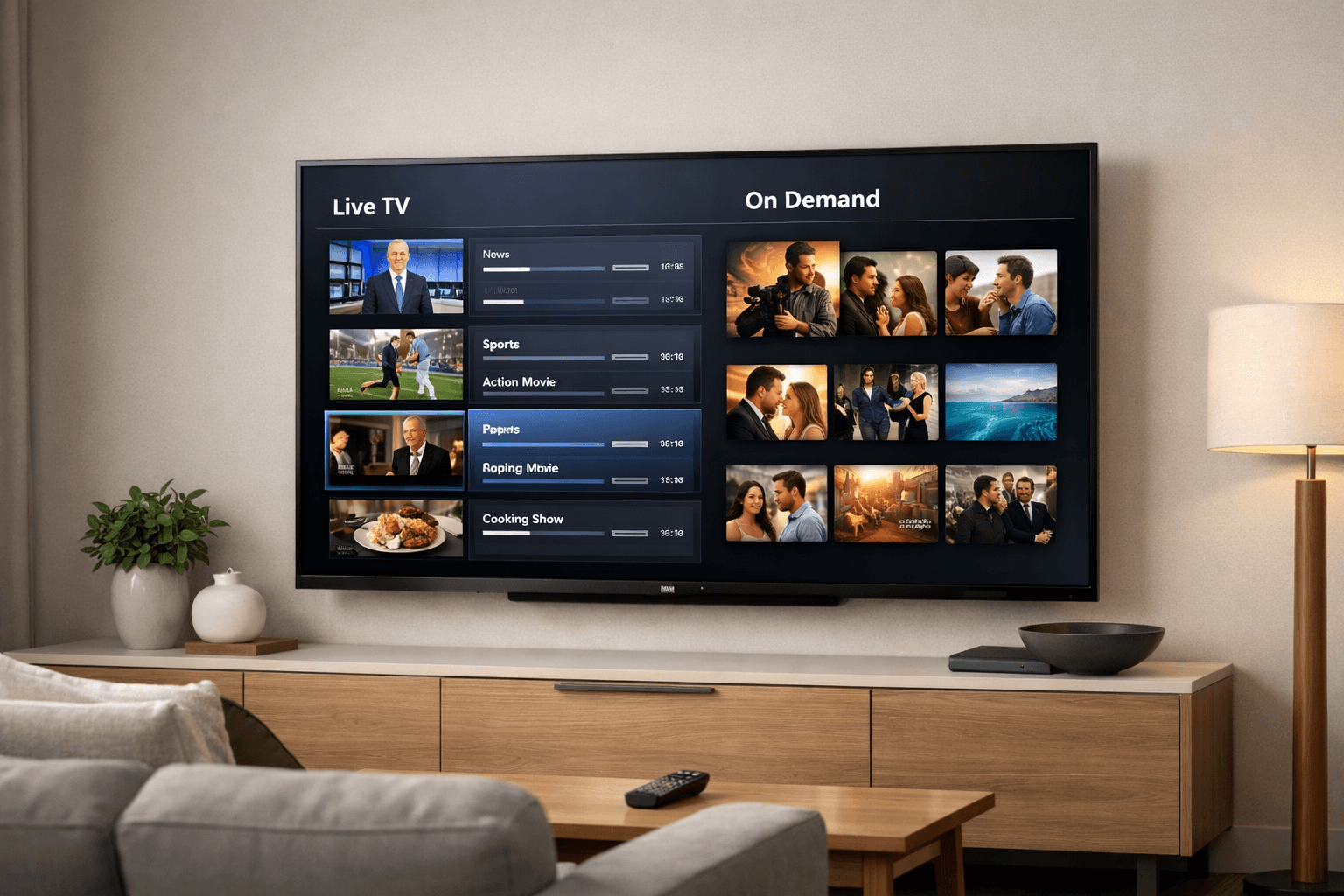
- Image prompt: Photorealistic modern UK living room. A smart TV shows a generic “Internet TV Service” dashboard with neutral cards (Live TV, VOD, Catch-up, EPG, Devices, Support). One streaming box and one remote on the table, plus a phone showing the same generic dashboard. No logos, no channel names, no copyrighted content. Soft daylight, realistic reflections, professional product photo, 16:9, high detail.
- SEO filename: iptv-service-uk-2026.webp
- Exact alt text: iptv service interface showing live TV channels and on-demand content
Table of contents
- What is an IPTV service?
- How an IPTV service works (simple flow)
- Types of IPTV services
- IPTV service vs traditional TV
- Benefits of using an IPTV service
- Devices that support IPTV services
- What to look for before subscribing (UK checklist)
- Free trial: what to test (fast plan)
- Is an IPTV service legal in the UK?
- FAQ
- External resources & related posts
1) What is an IPTV service?
An IPTV service delivers TV content over IP-based networks (the internet). Instead of broadcasting every channel to everyone at the same time, IPTV streams content when you request it — which enables features like on-demand libraries, multi-device viewing, and (sometimes) replay/catch-up.
Think of it like this: service = access to content; player/app = the tool that displays and plays it.
2) How an IPTV service works (simple flow)
At a high level, IPTV services follow a predictable chain:
- Content sourcing: content is acquired/managed (licensing depends on the provider).
- Encoding: video is compressed into streamable formats.
- Delivery: streams are served via internet servers/CDNs.
- Playback: you watch using an app/player on your device.
That’s why quality can vary: your home network, your device decoding power, and the provider’s infrastructure all affect the experience.
3) Types of IPTV services
Live IPTV
Real-time channels delivered online (closest to “normal TV”).
Video on Demand (VOD)
Libraries of films/series you watch anytime.
Time-shifted / catch-up
Replay features that let you watch previously aired programmes (when supported).
4) IPTV service vs traditional TV
| Aspect | IPTV service | Traditional TV |
|---|---|---|
| Delivery | Internet-based | Cable / Satellite |
| On-demand content | Common | More limited |
| Device support | Multi-device | Mostly TV-only |
| Flexibility | High (depends on plan) | Lower |
IPTV typically wins on flexibility — but it relies more on internet quality, Wi-Fi strength, and provider stability.
5) Benefits of using an IPTV service
- Flexible viewing: watch on multiple devices, not just one TV.
- Live + on-demand in one place: depending on what the plan includes.
- Potential for better control: favourites, categories, search, profiles.
- Efficient delivery: streams only when you request them.
- International variety: many services focus on multi-region libraries.
6) Devices that support IPTV services
Most IPTV services can be used with:
- Smart TVs (availability depends on TV ecosystem)
- Phones and tablets
- Laptops and desktops
- Streaming devices (Android TV / Fire TV / similar)
- Set-top boxes
For the smoothest viewing on a main TV, a dedicated streaming device with Ethernet usually beats weak built-in TV hardware.
7) What to look for before subscribing (UK checklist)
Instead of focusing on marketing claims, evaluate the experience where failures usually happen: evening peak hours, channel switching, EPG accuracy, and multi-device stability.
Stability at peak times
- Test 7–11pm local time
- Watch one live channel for 20–30 minutes
- Try switching quickly between categories
Device compatibility
- Confirm your main device is supported
- Test at least two devices if possible
- Check whether one device stutters more than others
EPG & usability
- Does the guide populate correctly?
- Are favourites easy to build?
- Do menus feel fast on your device?
Support and policy transparency
- Response speed (one simple question test)
- Clear terms/refund policy
- Account/device limits explained upfront
Decision support: IPTV Free Trial Guide (what to test) • IPTV Providers 2026 (ecosystem overview)
8) Free trial: what to test (fast plan)
A trial is the safest way to judge real performance on your own internet and devices. Use this simple test plan:
- Peak time test: 7–11pm, one live channel for 20–30 minutes.
- Switching test: 10 quick channel changes — note load time and failures.
- EPG test: verify guide populates and matches device time/timezone.
- Device test: try your main TV device + one phone/laptop.
- Support test: ask one setup question and track response time.
9) Is an IPTV service legal in the UK?
IPTV technology is legal. Whether a specific IPTV service is lawful depends on content licensing and distribution rights. For users, the safest approach is to only access content you’re authorised to view and to prioritise transparency in policies and support.
FAQ
What’s the difference between an IPTV service and an IPTV player?
An IPTV service provides access to content. An IPTV player is the app used to load and play that content on your device.
Why does IPTV buffer more in the evening?
Evening peak hours can stress home Wi-Fi, ISP routing, and upstream servers. That’s why peak-time testing is important.
Do I need fast internet for IPTV?
Stability matters more than raw speed. Ethernet or strong 5GHz Wi-Fi often makes a bigger difference than upgrading a plan.
Is a free trial worth it?
Yes. It’s the best way to validate performance on your real devices and connection before paying for a plan.
🌐 External resources
Neutral references (safe outbound linking, non-DMCA-adjacent).
- WIPO: Copyright basics
- UK NCSC: Staying secure online
- Internet Protocol television (Wikipedia)
- How streaming works (Cloudflare)
- Clear cache & cookies (Google Support)