

UK guide for safer streaming setup: understand what public playlists are, why they break, and how to reduce risk when testing an IPTV player.
Public IPTV Playlist: What It Is, How It Works, and What UK Users Should Know
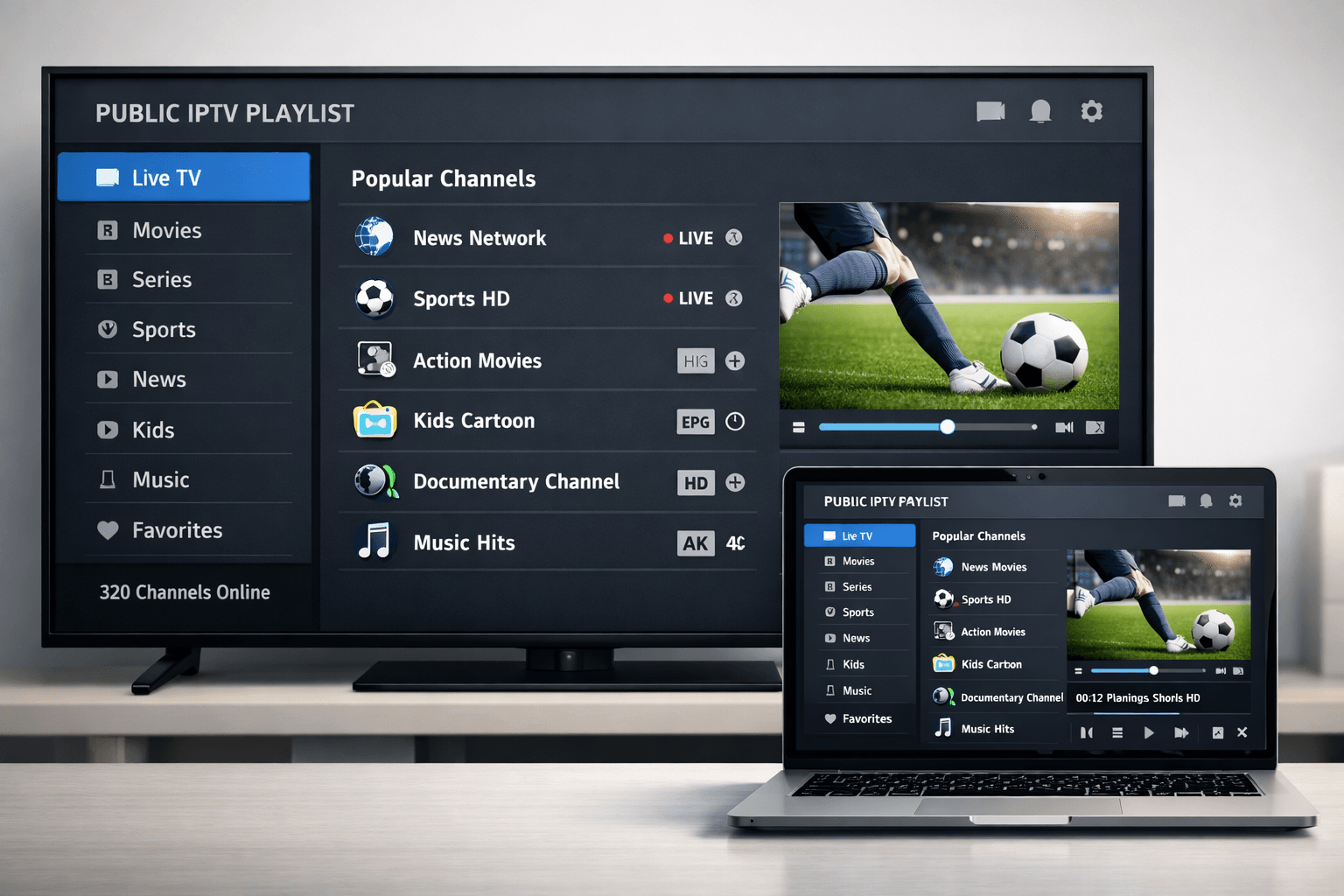
Hero image pack (copy/paste):
- Image prompt: Photorealistic close-up of a modern TV and a set-top box on a clean UK living-room media console. The TV shows a generic IPTV player interface with neutral categories (Live TV, EPG, Settings, Network Test) and a sample “Playlist Loaded” banner. No logos, no channel names, no copyrighted content, no brand marks. Soft daylight, realistic reflections, professional product-photo style, 16:9, high detail.
- SEO filename: public-iptv-playlist-uk-guide.webp
- Exact alt text: public iptv playlist loaded in an IPTV player showing channel categories (UK guide)
 What is a public IPTV playlist?
 What is a public IPTV playlist?
A public IPTV playlist is a freely shared list of streaming links that can be loaded into an IPTV player.
In most cases, it appears as either an M3U file (a text-based playlist format) or a playlist URL
that your app fetches over the internet. Once added, the player reads the list and displays items as channels, groups, or categories.
The key point is that a public playlist is usually not tied to your own account and often has
no support, no guarantees, and no long-term stability. Some public playlists are shared for legitimate reasons
(for example, public-domain streams, creator channels, or authorised test feeds). Others are posted without permission,
which can create legal and security risks for the user.
usually in M3U format or via a hosted playlist link.
How public IPTV playlists work (M3U files and playlist URLs)
 How public IPTV playlists work (M3U files and playlist URLs)
From a technical perspective, an IPTV player does three things after you add a playlist:
it downloads the playlist, parses the entries, and tries to play each stream
using the protocol each entry points to. The experience feels simple, but the reliability depends on what’s behind those links.
Common playlist formats you’ll see
- M3U / M3U8: A simple playlist text file. Many IPTV apps import this directly.
- Playlist URL: A web address that serves an M3U file. The app re-fetches it to refresh channel lists.
- EPG URL (optional): A separate link (often XMLTV) that populates guide data in the player.
What happens after import
- You paste a playlist URL (or upload an M3U file) into the IPTV player.
- The player downloads the list and builds categories and channel entries.
- When you press play, the app attempts to connect to the stream endpoint.
- If the endpoint is slow, blocked, or removed, you’ll see buffering, errors, or a blank screen.
Because public playlists are shared openly, they are frequently scraped, mirrored, blocked, rate-limited,
or taken offline. That’s why “it worked yesterday” is one of the most common complaints.
Why people use public IPTV playlists (and what they’re actually good for)
 Why people use public IPTV playlists (and what they’re actually good for)
It’s easy to understand the appeal: free access, quick setup, and the ability to test an IPTV app without committing to anything.
In reality, public playlists make the most sense for testing and learning, not for everyday viewing.
Good reasons (low risk)
- Testing whether a player works on your device (TV, box, mobile).
- Learning how playlists, EPG, and categories are organised.
- Checking network basics (Wi-Fi strength, router placement, Ethernet vs Wi-Fi).
- Playing authorised public streams (for example, official public channels).
Risky reasons (common pitfalls)
- Trying to replace a stable setup with “whatever is online today”.
- Importing unknown links from random posts or shortened URLs.
- Sharing playlist links publicly (often violates terms and increases takedowns).
- Assuming “free” means “safe” (it often doesn’t).
If your goal is to evaluate your setup, you’ll get better results by using a limited, authorised test playlist
(even a small list of known streams) rather than chasing huge lists that change daily.
Common limitations and risks (reliability + security)
 Common limitations and risks (reliability + security)
Public playlists tend to fail for predictable reasons: they are shared widely, hosted inconsistently,
and often depend on endpoints that were never intended to support large audiences. Even when they are legal,
they’re still frequently unreliable.
Reliability issues you should expect
- Links go dead: The stream endpoint is removed, changed, or blocked.
- Buffering spikes at peak time: The host can’t handle demand.
- Category chaos: Names and groups change, duplicates appear, and sorting breaks.
- EPG mismatch: Guide data often doesn’t align with channel entries.
- Resolution inconsistency: One stream may be stable while another drops constantly.
Security and privacy concerns (the part most people ignore)
Importing a playlist is not the same as downloading an app, but it still connects your device to unknown servers.
That creates a few practical risks:
- Tracking: Stream hosts can log IP addresses, user agents, and viewing patterns.
- Malicious redirects: Some links route through ad or tracking infrastructure.
- Suspicious companion sites: “Playlist pages” may push fake updates or unsafe downloads.
- Credential traps: If a player asks you to “log in” on an external website, treat it as a red flag.
“update codecs”, or enter credentials on a random site, stop. Use a safer test source.
Legal uncertainty (UK context, plain-English)
In the UK, legality generally depends on whether the stream is authorised by the rights holder.
Public playlists can mix legitimate and unauthorised streams in the same file, which is why the “grey area” label appears so often.
If you can’t verify authorisation, you should assume risk exists and avoid using it.
UK safety checklist for testing an IPTV player with public playlists
 UK safety checklist for testing an IPTV player with public playlists
If you’re using a public playlist for testing purposes, you can reduce your risk by focusing on three areas:
source hygiene, device hygiene, and network hygiene.
This is not about being paranoid; it’s about avoiding the most common mistakes.
1) Source hygiene (where the playlist comes from)
- Avoid link shorteners: Prefer direct URLs so you can see the domain clearly.
- Prefer reputable sources: Official public streams, well-known documentation sites, or curated open sources.
- Don’t chase “10,000 channel” claims: Bigger lists are usually less stable and more risky.
- Keep playlists local when possible: If you have authorised streams, store an M3U locally instead of relying on random hosted links.
2) Device hygiene (reduce exposure)
- Use a dedicated player: Avoid players that demand extra permissions unrelated to playback.
- Update your device OS: Many issues come from outdated firmware and security patches.
- Disable “unknown sources” installs: Don’t install add-ons from outside official app stores unless you fully trust them.
- Separate accounts: Don’t reuse important passwords inside streaming apps or related websites.
3) Network hygiene (stability + privacy)
- Test on Ethernet if possible: It removes a huge chunk of buffering problems.
- Check router placement: If Wi-Fi is required, reduce walls/interference and use 5GHz when available.
- Use DNS sensibly: Avoid sketchy DNS “boosters”. Use reputable DNS providers if you change anything.
- Monitor your bandwidth: If your home network is saturated, no playlist will feel stable.
the issue is usually Wi-Fi, device decoding, or app settings.
Public IPTV playlist vs IPTV subscription (high-level comparison)
 Public IPTV playlist vs IPTV subscription (high-level comparison)
Many users start by experimenting with a public playlist, then later switch to a more structured setup when they want consistency.
This section stays high-level on purpose and focuses on what typically changes in real-world use: uptime, organisation, and support.
| Aspect | Public IPTV playlist | Subscription-based setup |
|---|---|---|
| Cost | Often free | Paid |
| Stability | Usually inconsistent | Typically more consistent |
| Organisation | Varies widely; categories change | Usually curated categories + better naming |
| Support | None | May include support (depends on provider) |
| Best use | Testing and learning | Daily viewing and multi-device households |
If your goal is simply to confirm that your player works, a small authorised test playlist is enough.
If your goal is daily reliability, you’ll want a solution that is maintained, documented, and consistent.
Practical player settings that improve stability (without changing your provider)
 Practical player settings that improve stability (without changing your provider)
A lot of buffering complaints come from settings that don’t match the device or network.
These suggestions are general and safe, and they apply whether you are testing a playlist or using an organised setup.
Settings worth checking in most IPTV players
- Playback engine: If your app offers multiple players (native/external), test both.
- Buffer size: Moderate buffer helps with jitter, but huge buffers can cause long delays and “stuck” behaviour.
- Hardware decoding: Keep enabled on modern devices; disable only if you see audio/video desync or crashes.
- Stream format: If a link offers multiple variants, choose the most stable rather than the highest resolution.
- EPG refresh: Set to a reasonable schedule (daily or manual) so your app isn’t constantly re-fetching.
People often do it in the opposite order and waste hours.
Why public playlists disappear so quickly
 Why public playlists disappear so quickly
This is one of the most searched questions in the UK: “Why did my playlist stop working?”
The honest answer is that public playlists are fragile by design. They rely on endpoints that often have:
limited bandwidth, changing URLs, enforcement pressure, or basic hosting constraints.
The most common reasons
- Server limits: The host caps traffic or blocks heavy usage.
- Link rotation: URLs change to avoid scraping or because infrastructure changes.
- Geo restrictions: A stream may work in one region and fail in another.
- Takedowns: Links get removed when reported or when hosting rules change.
- Playlist “reposts”: Copies of copies become outdated, and users share broken versions.
If you see a playlist that has been reposted across many sites, that often means it’s already on borrowed time.
Related reading on IPTV setup
 Related reading on IPTV setup
If you want to improve stability and reduce random buffering, these guides usually help more than hunting playlists:
- Is IPTV safe and legal in the UK?
- What is IPTV and how it works (UK guide)
- Streaming setup basics for UK viewers
(If these slugs differ on your site, replace the links with the correct internal URLs—keep the anchor text.)
FAQs about public IPTV playlists
 FAQs about public IPTV playlists
Is a public IPTV playlist the same thing as an IPTV service?
Not really. A public playlist is just a list of links that a player can load. An IPTV service (in the general sense)
usually implies something maintained—consistent organisation, updates, and a structure around access.
A playlist can be part of a service, but a random public list is usually not maintained.
Why does a public playlist work for a few hours and then stop?
Because the underlying stream endpoints change, get overloaded, or are removed.
Public lists are also shared widely, which accelerates blocking and takedowns.
If you’re using playlists purely for testing, stick to small, authorised sources.
What is an M3U file?
An M3U file is a plain-text playlist format that lists media locations (URLs or file paths).
Many IPTV apps use M3U/M3U8 to import channel lists and group data.
Can public playlists harm my device?
A playlist itself is usually just text, but it can lead your player to connect to unknown servers.
The bigger risk is what happens around the playlist: unsafe websites, fake “updates”, and malicious downloads.
Use reputable sources and avoid installing anything prompted by random playlist pages.
How do I test an IPTV player safely?
Use a small list of authorised streams, test on a secure network, keep your device updated,
and avoid link shorteners or unknown “bundle” sites. Focus on network stability (Ethernet if possible),
then adjust buffer/decoder settings.
Do I need an EPG for a playlist?
You don’t need an EPG to test basic playback, but an EPG helps if you want the programme guide experience.
For public lists, EPG sources are often mismatched. If your goal is simply app testing, keep it simple.
Final thoughts
 Final thoughts
A public IPTV playlist can be useful when your goal is to learn how IPTV playlists work or to test whether a player
runs smoothly on your device. For day-to-day viewing, public lists often disappoint because they’re rarely stable, rarely curated,
and sometimes risky depending on the source.
If you treat public playlists as a short-term learning tool—and follow basic safety steps—you’ll avoid most of the common problems:
dead links, constant buffering, suspicious redirects, and wasted time. When consistency matters, prioritise a setup that is maintained,
documented, and aligned with authorised content access.
Neutral external resources
 Neutral external resources
These are general, non-provider resources about playlist formats, streaming basics, and online safety.
What is streaming? (Cloudflare Learning)
Staying secure online (UK National Cyber Security Centre)
Phishing and scam avoidance (FTC)
The rest use nofollow to keep the page audit-friendly and avoid risky outbound linking.