
IPTV Encoder Explained (UK, 2026): A Clear Guide for Streaming & Broadcasting
An IPTV encoder converts video input into a compressed digital stream that can be delivered over IP networks.
It’s a core “behind-the-scenes” building block used in live channels, event streaming, hospitality TV systems, and internal broadcasts.
If you’re learning the end-to-end delivery chain, start with IPTV streaming explained
and the overview of IPTV services.
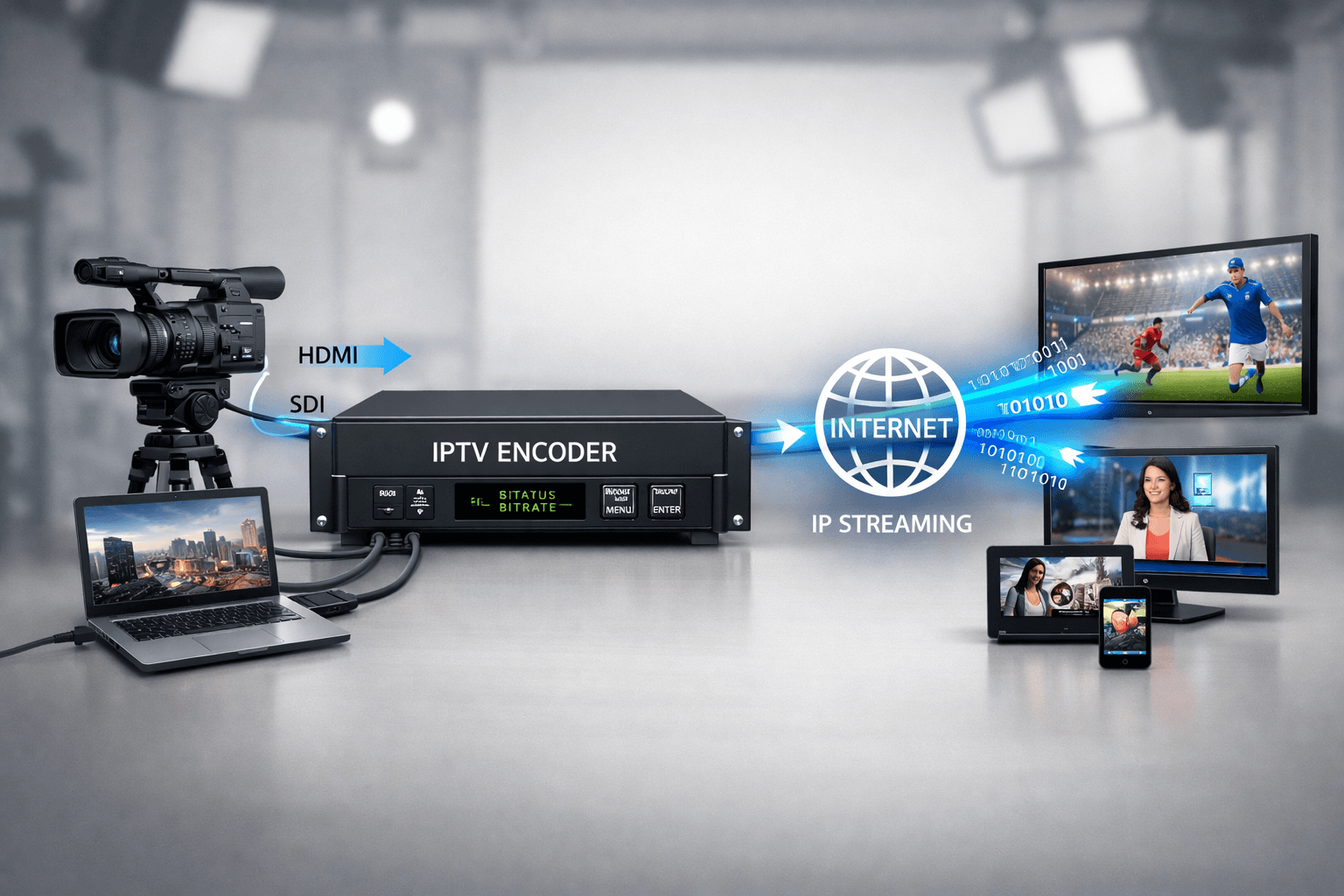
Hero image pack (copy/paste):
- Image prompt: Photorealistic close-up of a compact professional video encoder on a desk. Visible HDMI and SDI ports, status LEDs, and a small screen showing bitrate, resolution, and codec settings. A laptop beside it shows a generic “Stream Dashboard” with cards for Input, Codec, Bitrate, Output, Monitoring. No brand logos, no channel names, no copyrighted content. Soft studio lighting, realistic reflections, high detail, 16:9.
- SEO filename: iptv-encoder-uk-2026.webp
- Exact alt text: iptv encoder device converting video input into internet streaming format
Jump to Encoder vs server.
1) What an iptv encoder does
An encoder takes a video source (camera feed, receiver output, media player, studio mixer, etc.) and converts it into a compressed format
suitable for IP delivery. In practice, that means turning “raw” video into an efficient stream that can be transported over networks
and played reliably on different devices.
If you’re reading this as a viewer (not building infrastructure), an encoder isn’t something you normally buy.
It’s part of the production/broadcast side.
2) How encoding works (simple steps)
Most workflows look like this:
- Input capture: HDMI, SDI, IP feeds, AV, or similar.
- Compression: common codecs include H.264 or H.265/HEVC (choice affects quality and bandwidth).
- Packaging: audio + video are wrapped into a stream format suitable for transport.
- Output: the stream is sent to an IPTV server and/or CDN for delivery at scale.
3) Where encoders are used
Encoders show up anywhere video needs to run continuously or live with consistent quality:
Live channels & broadcast operations
Always-on streams where uptime and monitoring matter.
Sports & events
Fast motion and latency constraints make encoder settings more important.
Hotels & hospitality TV
Centralised distribution to many screens, often with managed networks.
Corporate & internal communications
Town halls, announcements, private live streams, training portals.
Education & training
Lecture capture, webinars, and replay libraries.
Infrastructure-side reading: IPTV service provider explained •
IPTV suppliers (infrastructure overview)
4) Hardware vs software (and channel counts)
Hardware encoders
- Purpose-built devices designed for stability and 24/7 use
- Often used in professional environments with monitoring
- Predictable performance (less dependent on OS updates)
Software encoders
- Runs on PCs/servers (more flexible and often cheaper)
- Performance depends on CPU/GPU, drivers, and system load
- Great for experimentation or scalable server workflows
Single-channel vs multi-channel
- Single-channel: one source → one stream
- Multi-channel: multiple inputs encoded simultaneously
- Plan for growth: adding channels later can change the hardware class
5) Encoder vs IPTV server
These are different layers of the stack:
| Component | Encoder | IPTV server/platform |
|---|---|---|
| Main job | Convert video input into a compressed stream | Distribute streams to users (scale, access, management) |
| Key focus | Codec settings, bitrate control, input/output reliability | Delivery, uptime, user management, caching/CDN, monitoring |
| Used together? | Yes | Yes |
If you’re mapping the “provider side” in plain terms, see what an IPTV service provider is.
6) Key features to evaluate
When selecting an encoder, the practical checklist usually includes:
- Input support: HDMI/SDI/IP and any required audio formats
- Resolution & frame rate: HD vs 4K, and what your workflow demands
- Codec options: H.264 vs H.265/HEVC (efficiency vs device support requirements)
- Bitrate control: CBR/VBR options, and how stable the output remains under motion
- Output compatibility: ensure it matches the downstream platform workflow
- Reliability: watchdog/restart behaviours, thermal stability, and 24/7 suitability
- Monitoring: basic health metrics so issues are visible quickly
Great encoding cannot fully compensate for weak delivery infrastructure or unstable networks.
7) How to choose the right encoder
A simple decision flow that avoids expensive mistakes:
- Define the job: live channel, events, hospitality TV, internal broadcasts, training library.
- List inputs: how many sources, which connectors, and whether audio must be embedded or separate.
- Set targets: resolution, expected viewers, and whether low latency is important.
- Match downstream: confirm your server/platform accepts the intended output workflow.
- Plan scaling: future channels, redundancy, and monitoring requirements.
Viewer-side setup (apps/players) is a different topic. Start here instead:
IPTV Smarters Player explained or IPTV player guide.
 Summary
 Summary
An encoder is foundational technology for delivering live and recorded video over IP networks. It transforms video inputs into efficient
streams that can be transported and distributed at scale. Understanding this layer helps explain what happens “before” content reaches
any playback app on a viewer’s device.
External resources
 External resources
Neutral, non-provider references (safe outbound linking).